
Executive Summary: The federal procurement rulebook is being overhauled at lightning speed. In 2025, President Trump’s EO 14275 and OMB guidance launched a FAR overhaul, stripping non-statutory text and replacing it with streamlined guidance[1][2]. In practice, “model deviation” clauses were released for major FAR parts (Part 19 on small business and others) in late 2025[3][4], and many agencies promptly issued class deviations adopting the new language. Policymakers justify this as cutting red tape and speeding up acquisitions[5][1]. However, contracting officers, primes, and especially small subcontractors now face a scramble: new compliance obligations, changed set-aside rules, faster payment clauses, and the risk of confusion. Small firms may need to update waivers, track performance ratios closely, and ensure they meet new flow-down requirements. The good news is some burdens (like excessive paperwork) may ease, and prime contractors have strong incentives to pass benefits like 15-day payments to subs[6]. To adapt, small contractors should proactively audit their contracts, seek guidance, and use technology (e.g. Procura’s AI tools[7][8]) to stay on top of the changing landscape.
Federal Buying Rewrite Impact
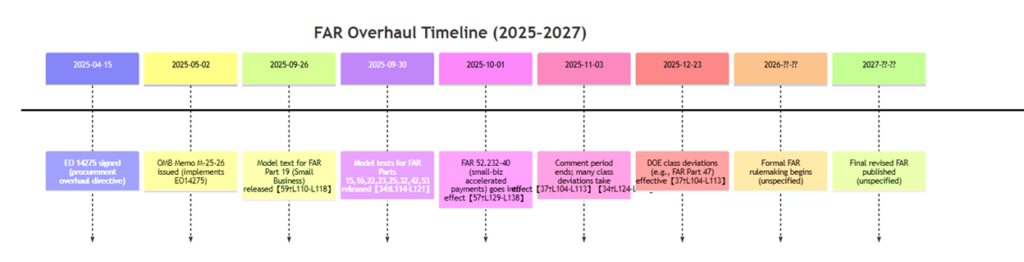
The transformation stems from EO 14275 (Apr 15, 2025) and OMB Memo M-25-26 (May 2025), which directed the FAR Council to excise non-essential provisions and rewrite regulations in plain language[1][9]. Key milestones include:
- Sept 26, 2025: The FAR Council published model deviation text for FAR Part 19 (Small Business) on Acquisition.gov[3]. This revision (part of the “Revolutionary FAR Overhaul”) was opened for informal comment through Nov 3, 2025[3]. GSA emphasized the goal of “removing non-statutory and non-essential content”[5].
- Sept 30, 2025: Model texts for other FAR parts (15, 16, 22, 23, 25, 32, 42, 53, etc.) were released simultaneously[10]. These guidebooks are intended to help contracting staff transition.
- Oct 1, 2025: A new clause FAR 52.232-40 became effective, requiring primes to make accelerated payments (≤15 days) to small-business subcontractors[6]. Primes must flow this clause down to all small-sb subs[11], effectively mandating faster payments.
- Nov 3, 2025: Most of the class deviations took effect. For example, GSA issued deviations fully adopting the new FAR language in its solicitations for Parts 15, 16, 25, 42, and more[12]. DOE and others issued similar deviations (e.g. Part 47 for vehicle procurements) by late November[13]. These deviations temporarily replace standard FAR clauses with the overhaul text.
- 2026 (unspecified): Formal FAR rulemaking will eventually incorporate these changes via the usual notice-and-comment process. Exact publication dates remain unspecified. Agencies have only a few months of runway before the new FAR versions are codified. In the interim, contracting may oscillate between old FAR and new deviation provisions, depending on the agency and solicitation.
RFO Timeline
Why They Did It (Policymaker Rationale)
Regulators claim the overhaul will simplify and speed up acquisitions. OMB explicitly argued that tens of thousands of pages of procurement rules had become a burden[1]. The new policy insists the FAR should contain only what’s legally required or critical for mission success[2]. In practical terms, that means shifting many of the FAR’s details into non-binding guidance (like the upcoming “buying guides”) and focusing the regulation on statutory mandates. GSA’s announcements talk about “plain language” and “practical tools” for implementing the new rules[5]. Advocates say this aligns federal procurement with the private sector, attracting new suppliers and allowing agencies to quickly adjust to needs (for example, GSA’s OneGov cloud buying reportedly saved millions in weeks).
Trade analysts also note benefits: fewer technical FAR provisions could mean fewer protests on minor points[14][15]. In small-business context, supporters hope streamlining the process will spur competition by making set-asides easier to use (and audit)[1][15]. But the overhaul’s ambition has drawn scrutiny. Critics argue that compressing the update timeline sacrifices clarity: as one comment notes, rolling out “class deviations” before formal rules means contractors must operate under an uncertain hybrid regime[16]. Industry observers caution that while the intent is noble, the transition is “as significant a change as we’ve seen in 40 years”[17] and may introduce new headaches (or loopholes) as it rolls out.
Real-World Impacts on COs, Prime Contractors, and Small Subs
Contracting Officers: COs are in “split mode.” Some new solicitations now use the revised FAR language, while others (and legacy contracts) use the old FAR. COs must decide whether to apply the new clauses midstream (a matter of agency policy)[18][19]. In practice, many agencies have instructed COs that new projects should incorporate the RFO deviations. This means learning new clauses quickly and updating templates. The good news for COs: the text is meant to be clearer and more to-the-point. The downside: every RFP or contract modification is a trap for the unwary. Even seasoned contracting officers may find themselves confirming, “Is this version of FAR 19 or 52 current?”
One concrete change: the Rule of Two (which normally mandates small-biz set-asides) was explicitly recast. Under the new model FAR, the Rule of Two is still mandatory for contract awards above the simplified acquisition threshold, but COs have discretion not to apply it on orders under IDIQs or GSA schedules[20][21]. In other words, a contracting officer can choose a large business on a task order even if small businesses exist, and that choice cannot be protested[20]. Agencies have also notified staff that they will conduct more compliance audits for small-business performance. COs are being told to verify that set-aside contractors are meeting the “50% performance by small business” rule on services[22], and to collect documentation accordingly. (This is why Emily Murphy says agencies are asking primes to prove small-business work content in their contracts[23].)
Prime Contractors: Large defense and IT contractors (primes) must adapt to a shifting rulebook in their subcontracts and proposals. Many must revise their standard subcontract agreements. For example, every subcontract with a small business must now contain the accelerated-payment clause 52.232-40[6]. Primes need to confirm that their payment systems will pay small subs within 15 days of receiving the government’s payment. Failure to do so could expose primes to audit findings or even penalties.
Additionally, primes should reassess their subcontracting plans. The new FAR language changes when and how goals are applied. If an order for $500k goes to award, it might no longer automatically trigger a small set-aside, even if two small vendors exist[20]. Conversely, primes will still have to ensure that any contract that is set aside meets the old performance rules. Agencies have signaled they will tighten oversight of subcontracting plan performance, possibly by sending letters or requiring more reporting about how much work small firms are doing[23]. In short, primes need to track their small supplier stats closely and be prepared to provide evidence of compliance.
Small Subcontractors: Small businesses are arguably the most affected. Many will see both opportunities and hurdles:
- Set-Aside Availability: With the Rule of Two relaxed for orders, billions of dollars of work that used to filter to small businesses through GWACs or Schedules may now be open to all competitors[20]. The American Small Business Chamber of Commerce warns that small-business contract share could drop from ~26% to ~16% under these reforms[24]. That means more competition and fewer guaranteed set-asides. Small subs should diversify their pipelines (e.g. consider direct 8(a) or HUBZone contracts, or other agencies) in case some programs shrink.
- Compliance Burden: On set-aside contracts, enforcement is ramping up. If a small subcontractor is supplying products, every item must be made by a U.S. small business (nonmanufacturer rule)[22]. There’s no percentage fudge factor – for example, if a small firm is reselling laptops, those laptops must themselves be manufactured by a U.S. small business, unless SBA waives this restriction[22]. Emily Murphy warns that many small businesses don’t realize this requirement exists and could fail audits. The advice: get your waivers and documentation ready[23]. If you’re a small tech or hardware firm, check SBA’s regulations (13 CFR 121.406(b)) now for details[25].
- Payment Terms: This is one positive change for small subs. FAR 52.232-40 means if you’re a certified small business, you should be paid within 15 days of a prime getting paid[6]. This is a big improvement over the typical 30-day cycle, and primes cannot levy fees on this fast pay[26]. So, plan for better cash flow and ensure your invoices are submitted promptly.
- Subcontracting Plans and Reporting: Even if you’re a first-tier sub, agencies might soon demand your buy-in to compliance. For instance, some agencies are requiring prime contractors to obtain small subs’ compliance certificates for certain clauses (like cybersecurity or origin of goods). Small subs should be aware that primes may now ask for data or certifications on every subcontract. Be prepared to share evidence of your small status (and relevant waivers) to keep your contract healthy.
Risks, Uncertainties, Implementation Challenges
The quickest rule changes in decades come with headaches:
- Which rules apply when? There’s confusion over whether to use the old FAR text or the new deviation text on a given solicitation. Agencies have discretionary guidance, but not all COs and contractors interpret it the same way. It’s possible to bid under one rule set and be awarded under another. This creates protest risk and legal ambiguity. One law firm notes that relying on class deviations means “near-term uncertainty” about what actually governs a contract[16].
- Patchwork roll-out: Some agencies (GSA, DOE, etc.) moved fast with deviations, while others are slower. This means a company might see entirely different rules on two similar contracts. Also, vehicle transitions (like CIO-SP AWOL) raise questions: e.g. GSA’s SEWP merging, CIO-SP4 cancellation, may redirect work but also create confusion about subcontracting.
- Complexity for small businesses: As noted, small subs now face sharp new compliance obligations. Failure to understand these can lead to False Claims Act risk. For example, a sub that wasn’t aware of the nonmanufacturer rule might inadvertently violate it, and under a strict liability theory could face penalties if caught. On top of that, some changes in FAR may not align perfectly with SBA regs, causing a mis-step. For instance, the new FAR suggests automatically allowing 8(a) requirements to convert to a HUBZone or SDVOSB set-aside[27], but SBA’s rules still require a formal release. Contractors must watch for such inconsistencies.
- Implementation Load: Agencies themselves must retrain staff and rewrite countless templates and internal guides. There’s a risk of errors or omissions in this transition. FAR Council promised “practical tools” and albums to ease the shift[5], but if those guides lag behind, COs and contractors may have to “learn on the fly.” All this means contract administration could be slower or more error-prone in 2026 until the dust settles.
Mitigation Strategies & Recommended Actions
Small federal subcontractors should move from reaction to action. Here’s how to stay ahead of the changes:
- Educate Your Team: Assign someone (e.g. project manager or compliance lead) to study the new rules. Read the updated FAR Part 19 text and SBA guidance[25]. Sign up for FAR Council newsletters and industry news. Understand exactly what changed (like the nonmanufacturer and 50% rules).
- Review Current Contracts: Check active set-aside contracts for any new FAR references. If you’re on an order, verify whether the CO has applied the new FAR text or not. Look for deviations or added clauses (especially in high-dollar tasks). Ensure any subcontracts include the accelerated payment clause if you’re a small business[6].
- Verify Small Business Status: Now is a good time to confirm your SBA status and ensure nothing has lapsed. If you’re acting as a wholesaler or dealer, identify any products you resell that weren’t made by a small business. If so, apply immediately for SBA waivers, or find alternative sourcing. Keep robust documentation of your manufacturing sources and work performed (to satisfy the 50% rule).
- Adjust Subcontracting Plans: If you are a prime contractor, update your plans and goals. If you are a small prime or joint venture, make sure your plans account for the new set-aside criteria. Monitor your small-supplier participation percentages closely and keep records, as auditors will be watching.
- Engage Up and Down the Chain: Communicate with your prime(s) about how these changes affect your work. Ask if they are issuing new guidance or training. If you’re the prime, proactively explain the impacts to your subs. Consider meeting with your agency CO or small-business point of contact to clarify how to handle questions about the new rules.
- Leverage Technology: The faster contracting cycles and new clauses mean manual tracking is hard. Procura Federal (procurafederal.com) is one example of a tool that can help small businesses keep up. Procura is an AI-powered contract search and analysis platform for small companies[7]. After you set up your capabilities, Procura scans SAM.gov and reads entire RFPs (including attachments), then provides a “fit score” and plain-language summary[8]. It will flag unusual requirements or new compliance clauses – for example, if a solicitation suddenly includes a new cybersecurity clause or origin requirement, Procura will highlight it. This saves small teams hours of manual searching. (To learn more, see procurafederal.com or book a demo[7][8].)
- Industry Resources: Join trade associations like NCMA or small-business coalitions. Attend webinars on the FAR overhaul. SBA’s Office of Government Contracting sometimes offers guidance. Stay in touch with peers: many small firms are working through the same questions and may share tips (e.g., how to handle a prime asking for SBA waivers).
- Provide Feedback: If you can still comment on draft rules or agency deviations, do so. The informal comment window has closed, but agencies may still accept input on implementation. Even alerting a CO to a confusion (via a bid protest exception or question) may influence how flexibly they apply new clauses.
Below is a checklist (Table B) summarizing these actions for quick reference:
| Recommended Action | Priority | Effort |
| Read updated FAR/SBA guidance on small-business | High | 2–3 days |
| Audit active contracts for new FAR clauses | High | Moderate |
| Ensure compliance with nonmanufacturer rule | High | Moderate (legal) |
| Update subcontracting plans & track SB performance | High | Moderate |
| Incorporate FAR 52.232-40 (15-day pay) if SB | High | Low |
| Use Procura (or similar tool) for opportunity intel[7] | Medium | ~1 day setup |
| Communicate with primes/COs on new requirements | Medium | Low |
| Participate in industry webinars | Medium | Ongoing |
| Monitor agency FAR deviations and guidance updates | Medium | Ongoing |
Example Scenario: An IT Small Biz in 2026
CyberSecure LLC is a 50-person SDVOSB specializing in network security. They recently won a $1.5M set-aside task to install secure routers on a Navy base. Suddenly, two new things appear in the requirement:
- Accelerated Payment Clause (FAR 52.232-40). CyberSecure notices the contract now has a clause promising payment within 15 days of the government’s payment. This is new, so they revise their cash-flow plan. Instead of waiting 30 days, they confirm they can invoice immediately and expect payment quickly[6]. This improves their cash position, but also means they must be prompt with invoices.
- Nonmanufacturer Rule Check. The task includes special routers. CyberSecure had planned to buy those routers from a major foreign manufacturer (a common scenario). However, remembering the new rule[22], they realize they need a waiver: either they find a U.S. small manufacturer of those routers or get SBA’s permission. They check SBA’s site (13 CFR 121.406(b)) and apply for a waiver immediately. Meanwhile, they document the sourcing of components and how their labor costs (50%+ of work) satisfy the 50% rule.
Because CyberSecure was proactive, they avoid delays. They also subscribe to Procura, which alerts them to a couple of other Navy cybersecurity opportunities they would have missed – one under a GWAC and one a small-business stand-alone contract. Procura’s bid/no-bid recommendation lets them focus on the proposal that best fits their profile[8]. In this way, CyberSecure turns the rule changes into competitive advantages rather than setbacks.
Tables
Table A: Key Rule Changes and Effects on Primes vs. Small Subs
| Rule/Clause | Impact on Prime Contractors | Impact on Small Subcontractors |
| FAR Part 19 rewrite (small biz) | More discretion: COs can skip set-asides on orders[20]. Primes may face more competition on GWACs/schedules. | Fewer guaranteed orders: small subs may find fewer set-aside tasks on MA contracts[20]. Must compete on full contracts. |
| Rule of Two (revised) | Can use large vendors on orders even if 2 SBs available[20]. | Reduced odds: small biz may lose opportunity even when they qualify. CO decisions are final, not protestable[20]. |
| Nonmanufacturer rule (FAR 19.102) | Must ensure subcontracted goods meet the rule (or secure waivers)[22]. | Must verify waivers or domestic source for products[22][23]. Extra paperwork/costs to prove compliance. |
| Size recertification (orders) | Less admin: no automatic size recert for each order[28]. | Generally no new self-cert for each order (simpler process). But SBA regs still allow COs to ask for it[29]. |
| Accelerated payments (52.232-40) | Must pass on payments to small subs within 15 days[6]. Update invoicing. | Quicker cash: small subs get paid sooner, improving cash flow[6]. |
| Subcontracting plan/reporting | May need updated goals/reporting to align with changes. Increased scrutiny of SB performance. | Higher reporting: small subs will need to provide data (e.g. % of work done) to prove plan compliance[23]. |
| Cybersecurity/CUI flow-down | DFARS clauses (CMMC, etc.) still flow to subs; primes ensure compliance. | Must meet CMMC/CUI requirements if flowing down (possibly costly upgrades). |
| Statutory vs. Guidance | Agencies can follow “buying guides” rather than strict FAR rules. | May face guidance that’s less clear. Must interpret best practices. |
Table B: Action Checklist for Small Subcontractors
| Action Item | Priority | Effort |
| Review updated FAR Part 19 and SBA regs | High | 1–3 days |
| Audit current contracts for new clauses | High | Moderate |
| Ensure nonmanufacturer waivers/documentation | High | Moderate (legal) |
| Track 50% performance/limitation requirements | High | Moderate |
| Verify inclusion of FAR 52.232-40 (fast pay) | High | Low |
| Engage prime/CO about rule changes | Medium | Low |
| Use AI tools (e.g. Procura) for RFP analysis[7] | Medium | ~1 day setup |
| Attend FAR overhaul webinars/training | Medium | Ongoing |
| Monitor FAR Council/agency updates | Medium | Ongoing |
Meet with the Procura Team to See How We Can Help
[1] Overhauling the Federal Acquisition Regulation
[2] [15] FAR 2.0: A Transformative Rewrite of Federal Acquisition Regulation in 2025 | Insights | BRG
[3] [5] [9] FAR Overhaul New Model Deviation Text for Part 19 | Acquisition.GOV
https://www.acquisition.gov/content/far-overhaul-new-model-deviation-text-part-19
[4] [13] [18] [19] November 3, 2025: A Key Date in the FAR Overhaul Process | BuildSmart https://www.buildsmartbradley.com/2025/10/november-3-2025-a-key-date-in-the-far-overhaul-process/
[6] [11] [26] 52.232-40 Providing Accelerated Payments to Small Business Subcontractors. | Acquisition.GOV
https://www.acquisition.gov/far/52.232-40
[7] [8] Procura for Small Business Government Contractors – Find Federal Contracts Faster
https://procurafederal.com/solutions/small-business
[10] [12] Weekly Update for Government Contractors and Commercial Businesses – October 9, 2025 | PilieroMazza, Law Firm, Government Contracts Attorney https://www.pilieromazza.com/weekly-update-for-government-contractors-and-commercial-businesses-october-9-2025/
http://www.gsacncma.com/files/CM2507_MultiArticles.pdf
[16] Decoding the FAR Overhaul: Wiley
https://www.wiley.law/decoding-the-far-overhaul
[20] [21] [27] [28] [29] Big Changes to Small Business Regulations? An Overview of the FAR Part 19 Rewrite | Miles & Stockbridge P.C. – JDSupra
https://www.jdsupra.com/legalnews/big-changes-to-small-business-8455697
[22] [23] [25] Real-time rewrite of federal buying rules is roiling acquisition | Federal News Network https://federalnewsnetwork.com/contracting/2026/02/real-time-rewrite-of-federal-buying-rules-is-roiling-acquisition/
[24] Far Modernization Analysis — The American Small Business Chamber of Commerce